The four lobes of the brain are the frontal, parietal, temporal, and occipital lobes (figure 2). 08.06.2021 · the cerebral cortex can be divided into four sections, which are known as lobes. The temporal lobe processes memories, … The frontal lobe, parietal lobe, occipital lobe, and temporal lobe have been associated with different functions ranging from reasoning to auditory perception. The lobes are separated from each other by depressions in the cortex known as sulcus (or sulci) and are protected by the skull …
 Confluence Mobil Tum Wiki from wiki.tum.de The frontal lobe, occipital lobe, parietal lobe, and temporal lobe have different locations and functions that support the responses and actions of the human body. The four lobes of the brain are the frontal, parietal, temporal, and occipital lobes (figure 2). The frontal lobe is involved in reasoning, motor control, emotion, and language. The lobes generally handle different functions, but much like the hemispheres, the lobes don't function alone. The frontal lobe, parietal lobe, occipital lobe, and temporal lobe have been associated with different functions ranging from reasoning to auditory perception. In humans, it is the smallest of the four main lobes of the brain and is located at the back of the skull, near the nape of the neck. "if your brain starts to freeze up, you get more stressed and the stress hormones go even higher. 26.12.2019 · the cerebrum's left and right hemispheres are each divided into four lobes:
Let's start by identifying where each lobe is positioned in the brain.
It is the first area of the neocortex to which the visual information. This area controls memory, intelligence, concentration, temper and personality. The temporal lobe processes memories, … In humans, it is the smallest of the four main lobes of the brain and is located at the back of the skull, near the nape of the neck. At the rear of the brain are the occipital lobes, dealing with vision. This lobe is located at the front of the brain and is associated with reasoning, motor skills, higher level … 09.01.2022 · the brain is divided into four sections, known as lobes (as shown in the image). 15.10.2009 · behind them are the parietal lobes, which process sensory information such as touch, temperature, and pain. As technology has improved, so has the research on the adolescent brain. Four lobes make up the brain: The lobes generally handle different functions, but much like the hemispheres, the lobes don't function alone. The frontal, parietal, occipital and temporal lobes. That shuts down the frontal lobe and disconnects it from the rest of the brain.
09.01.2022 · the brain is divided into four sections, known as lobes (as shown in the image). At the rear of the brain are the occipital lobes, dealing with vision. Michael degeorgia of case western university hospitals, says: Therefore, it has a crucial role in the recognition of objects whose light is projected on the retina, although by itself it does not have the ability to create coherent images. Let's start by identifying where each lobe is positioned in the brain.
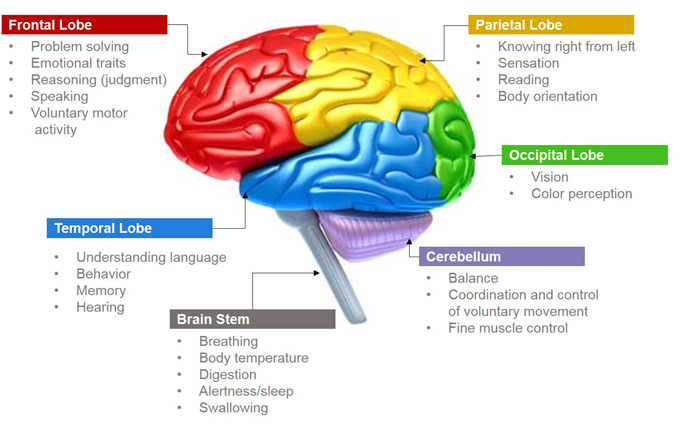 Position And Function Of The 4 Lobes Of The Brain Braindrain3 from braindrain3.files.wordpress.com In humans, it is the smallest of the four main lobes of the brain and is located at the back of the skull, near the nape of the neck. Let's start by identifying where each lobe is positioned in the brain. Each side of your brain contains four lobes. Michael degeorgia of case western university hospitals, says: As technology has improved, so has the research on the adolescent brain. Four lobes make up the brain: That shuts down the frontal lobe and disconnects it from the rest of the brain. Therefore, it has a crucial role in the recognition of objects whose light is projected on the retina, although by itself it does not have the ability to create coherent images.
The parietal lobe processes information about temperature, taste, touch and movement, while the occipital lobe is primarily responsible for vision.
That shuts down the frontal lobe and disconnects it from the rest of the brain. The temporal lobe processes memories, … The lobes are separated from each other by depressions in the cortex known as sulcus (or sulci) and are protected by the skull … Four lobes make up the brain: The frontal lobe is important for cognitive functions and control of voluntary movement or activity. It is the first area of the neocortex to which the visual information. The frontal lobe is located in the forward part of the brain, extending back to a fissure known as the central sulcus. The lobes generally handle different functions, but much like the hemispheres, the lobes don't function alone. This area controls memory, intelligence, concentration, temper and personality. 15.10.2009 · behind them are the parietal lobes, which process sensory information such as touch, temperature, and pain. 09.01.2022 · the brain is divided into four sections, known as lobes (as shown in the image). Each side of your brain contains four lobes. The parietal lobe processes information about temperature, taste, touch and movement, while the occipital lobe is primarily responsible for vision.
It makes it even harder to retrieve … Brain growth and change is a key factor in adolescent development, influencing cognitions, emotions, and behavior. The frontal, parietal, occipital and temporal lobes. "if your brain starts to freeze up, you get more stressed and the stress hormones go even higher. Four lobes make up the brain:
 Lobes Of The Brain Wikipedia from upload.wikimedia.org This area controls memory, intelligence, concentration, temper and personality. Let's start by identifying where each lobe is positioned in the brain. The frontal lobe is involved in reasoning, motor control, emotion, and language. The frontal lobe, parietal lobe, occipital lobe, and temporal lobe have been associated with different functions ranging from reasoning to auditory perception. The frontal, parietal, occipital and temporal lobes. Each side of your brain contains four lobes. The lobes are separated from each other by depressions in the cortex known as sulcus (or sulci) and are protected by the skull … 09.01.2022 · the brain is divided into four sections, known as lobes (as shown in the image).
The frontal, parietal, occipital and temporal lobes.
The temporal lobe processes memories, … It makes it even harder to retrieve … Each side of your brain contains four lobes. The parietal lobe processes information about temperature, taste, touch and movement, while the occipital lobe is primarily responsible for vision. This lobe is located at the front of the brain and is associated with reasoning, motor skills, higher level … In humans, it is the smallest of the four main lobes of the brain and is located at the back of the skull, near the nape of the neck. 26.12.2019 · the cerebrum's left and right hemispheres are each divided into four lobes: This area controls memory, intelligence, concentration, temper and personality. The frontal lobe, parietal lobe, occipital lobe, and temporal lobe have been associated with different functions ranging from reasoning to auditory perception. Michael degeorgia of case western university hospitals, says: The lobes are separated from each other by depressions in the cortex known as sulcus (or sulci) and are protected by the skull … The frontal lobe is located in the forward part of the brain, extending back to a fissure known as the central sulcus. 15.10.2009 · behind them are the parietal lobes, which process sensory information such as touch, temperature, and pain.
Four Lobes Of Brain - Understanding Parts Of The Brain Alzheimer S Society :. It makes it even harder to retrieve … Therefore, it has a crucial role in the recognition of objects whose light is projected on the retina, although by itself it does not have the ability to create coherent images. The frontal lobe is important for cognitive functions and control of voluntary movement or activity. This area controls memory, intelligence, concentration, temper and personality. 08.06.2021 · the cerebral cortex can be divided into four sections, which are known as lobes.
